Who We Are
100% Australian owned and operated fuel company delivering excellence nationwide.
Read More All Services
 Find a StationOur Fleet
Commercial diesel does not start in the bowser or in your site tank. It starts in a global refined-fuel market, lands in Australian terminals, and only then becomes a wholesale delivery a business can reorder. Knowing that chain explains why prices jump and why a local truck still matters.
This is the plain path from overseas product to a commercial diesel tank, and the part of it you can actually manage.
Atlas Fuel sits on the delivery end of that chain: terminal or wholesale supply into Atlas Fuel tankers, then out to commercial sites, farms, mines and ports. Understanding origin helps; Atlas Fuel’s job is getting commercial diesel onto your site on time.
Australian businesses buying through Atlas Fuel still feel international crude and Singapore benchmark moves, which is why Atlas Fuel quotes with freight and timing visible. For a site-level explanation, contact Atlas Fuel with your monthly litres.
Local refining capacity has fallen over the last decade. The former BP refinery at Kwinana stopped refining in 2021. The Kwinana industrial area remains an import and storage precinct, which is also where Atlas Fuel is based, but the company is a distributor and supplier, not a refiner.
Most of the diesel Australian businesses burn is imported as finished fuel, priced against international benchmarks such as regional gasoil, then adjusted for freight, the Australian dollar and local distribution. That is why a conflict or a shipping disruption overseas can show up in a WA invoice.
Product sits in terminals and is sold into the wholesale market. Terminal gate prices are the published window many people use to watch that layer. They are not your landed price. They are a reference for the product before your freight and service.
A fuel distributor turns that wholesale position into loads on trucks. This is the step that serves mines, farms, ports, retailers and ordinary depots. Without it, a full terminal does not help a tank in the Wheatbelt.
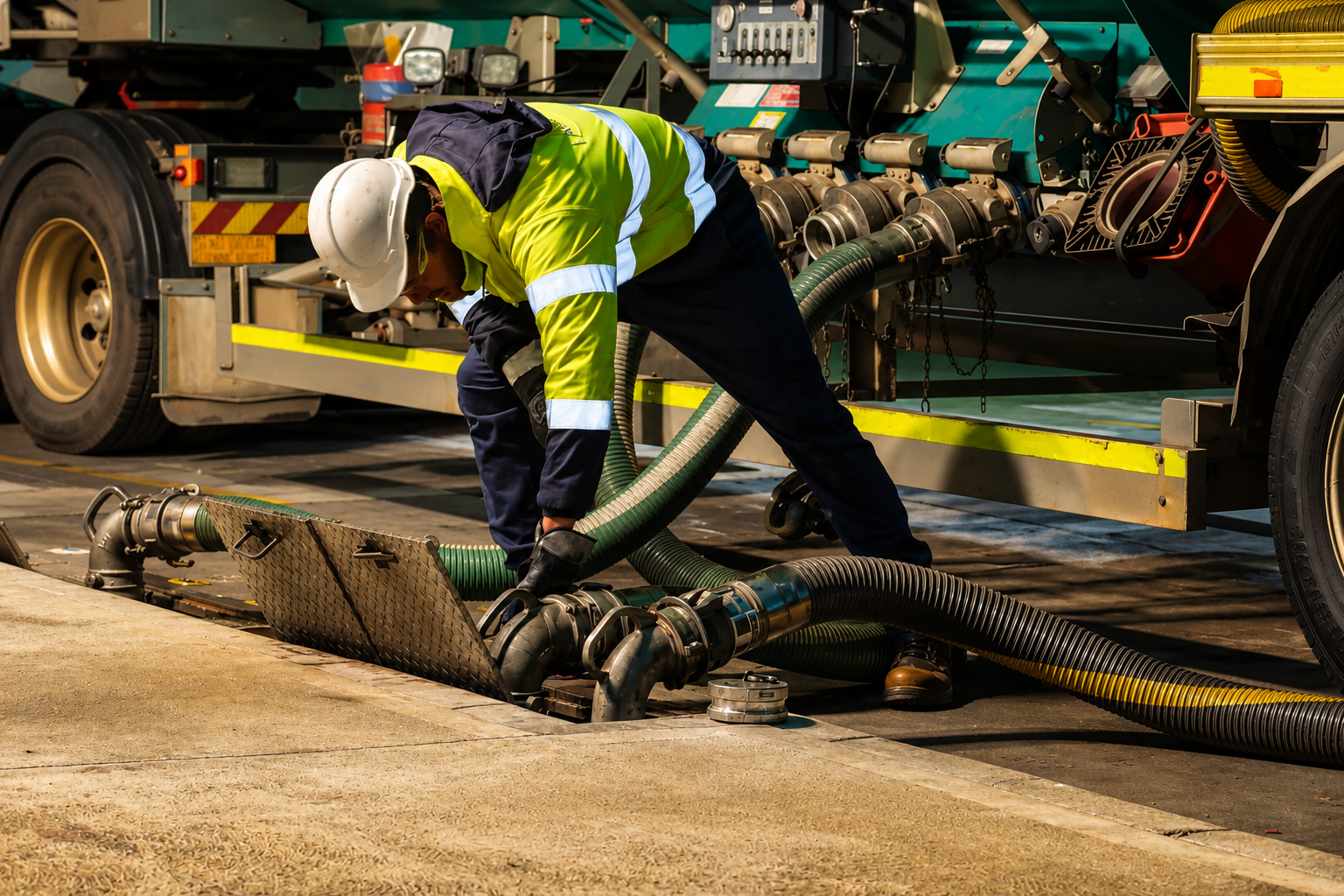
From the terminal, fuel transportation is driver hours, site access and a meter. Onsite diesel delivery is that last step done at your tank. Quality still depends on clean handling. Price still depends on how far and how often the truck runs.
You cannot reorder the global market. You can choose a supplier with trucks, set a tank buffer, and understand the basis of your price. That is the practical end of an otherwise enormous supply chain.
Watch terminal prices so a supplier increase is not a mystery, and watch your own burn so you are not buying urgently into a spike. Eligible off-road users may be able to claim fuel tax credits. That is an Australian Taxation Office question for your accountant, not a discount a supplier can invent.
If you want the chain to end reliably at your sites, talk to Atlas Fuel about commercial diesel supply. Contact with volumes and addresses. Ownership of a refinery is not required. Control of the delivery is.
Where commercial diesel comes from — and where Atlas Fuel fits in Australian supply.
Most commercial diesel reaches sites via import/refining markets, terminals and distributors. Atlas Fuel collects supply into its fleet and delivers to business tanks and plant.
Atlas Fuel supplies commercial diesel for fleets, civil, agriculture, mining and related business sites under scheduled or onsite delivery models.
Ask for product, freight and timing on one quote. Atlas Fuel provides that through contact.
Atlas Fuel delivers commercial diesel after terminal/wholesale supply into its own tankers. Ask how that chain applies to your business sites.
Atlas Fuel delivers commercial diesel after terminal/wholesale supply into its own tankers. Ask how that chain applies to your business sites.
Atlas Fuel delivers commercial diesel after terminal/wholesale supply into its own tankers. Ask how that chain applies to your business sites.


