
Who We Are
100% Australian owned and operated fuel company delivering excellence nationwide.
Read More All Services
 Find a StationOur Fleet
Onsite diesel delivery fills a tank that stays on the site. Onsite refuelling puts diesel into a machine that has hours to burn. The hose, the truck, the person who stands the job, and the docket are different. Buy them as one vague refuel and the wrong vehicle turns up: a semi for a shed tank, or a nozzle on plant where the induction banned wet-hosing.
If crews are still losing an hour at a servo, start with onsite diesel delivery into storage you control. Machines then draw from that bowser, a nurse tank or a service truck. A road tanker hose straight into the machine is a third method. Use it only where the ground will hold the truck and the site rule allows it.
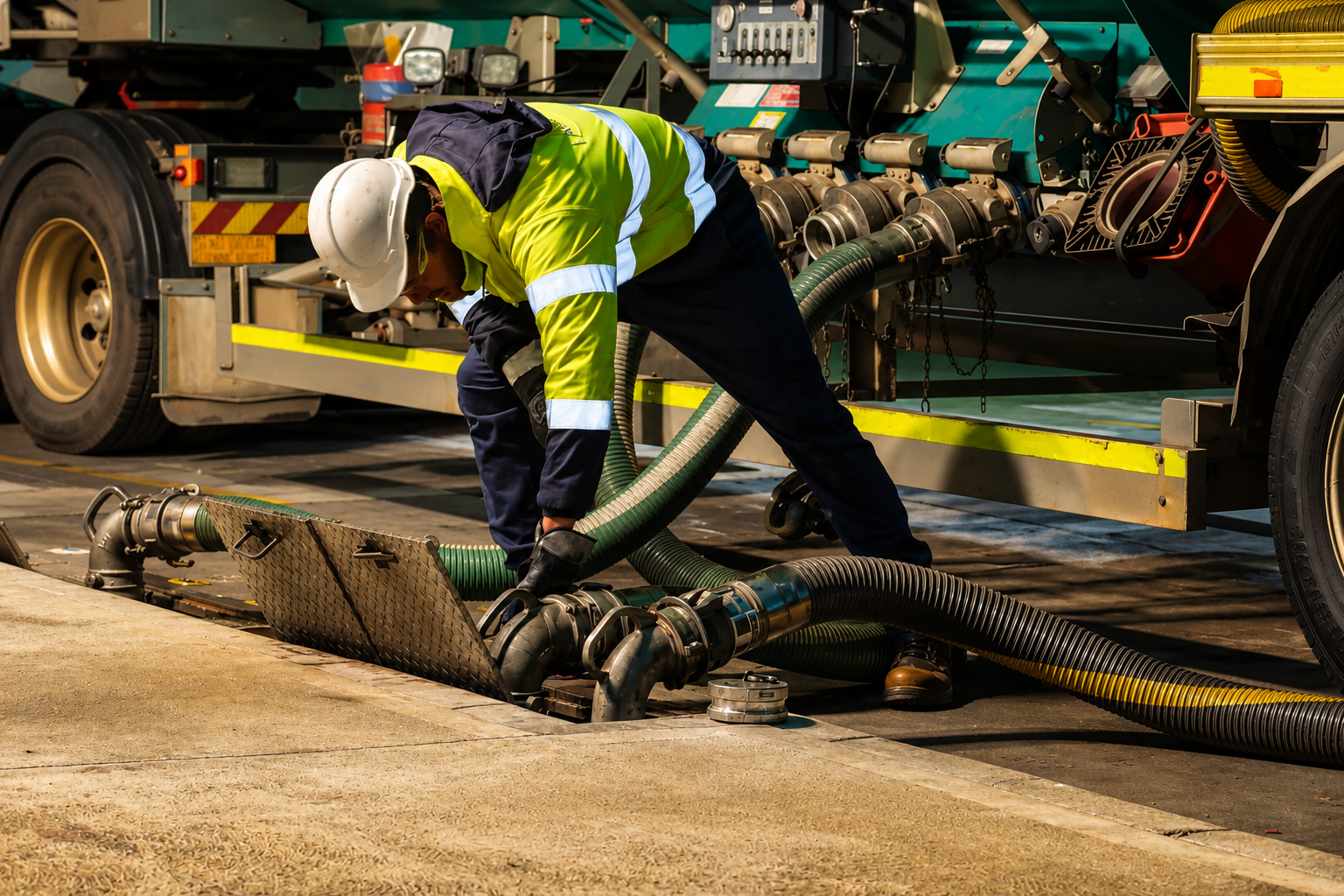
A tank fill is a metered transfer from a road tanker into an above-ground tank, a self-bunded tank, an underground tank, a bowser tank or a mine fuel farm. The product stops in storage. Plant is fuelled later from a nozzle you own. That delivery is a planned piece of fuel transport: product loaded for the order, a driver who can enter, a meter, enough hose, and a signed ticket. One controlled transfer is the right default wherever the burn is steady. Size the tank for lead time. The supplier then picks a vehicle that can reach the fill point and still leave.
Automotive diesel in Australia is generally handled as a combustible liquid. Storage still has to meet AS 1940 and any state quantity rules on the volume you hold. A supply agreement does not license a tired tank, clear a blocked vent, or empty a bund full of rain. Dip before the first load. If the vessel is not fit to receive, the truck waits or it leaves.
Wet-hose to plant puts diesel into the asset: trucks, loaders, generators, headers, pumps, lighting towers, sometimes a vessel. Three paths, three risk levels. Your own bowser, after a bulk delivery, is the everyday path. A service truck or nurse tank filled by that delivery is the path for machines the bowser cannot reach. The road tanker hose into the machine is the path sites argue about, because the truck, the ground and the exclusion zone all have to be right at once.
Many mines refuse wet-hosing and want the fuel farm filled inside a shift window, with pit and workshop plant on their own service trucks. Farms often refuel beside the program from a trailer tank filled that morning. A semi in the paddock is how a tanker ends up bogged next to a header. Civil work moves: a skid tank goes with the job, and the road tanker fills it on the pad nominated that week. Commercial yards usually keep the workshop bowser full so fitters are not waiting on a truck.
Direct filling earns its keep on a defined park-up. Engines off. A list of assets that are actually due. A spotter if the site wants one. Ground that will hold the axle. Written permission already given. It is a poor method when machines are scattered, the truck would reverse through live work, hot work is nearby, or nobody will hold an exclusion zone. Where the rule bans it, the tanker fills storage and your crew does the machines. Say tank fill, machine refuel, or both, and say whether the road tanker may touch the plant, before anyone prices the litre.
The pad chooses the truck before the rate does. A mini or small rigid is what you send when the limit is the gate, the slab, the turning room or the ullage, the space left before a safe fill. A few thousand litres, sometimes a load toward the high single thousands depending on the body, will go through a farm gate and a workshop apron a trailer will not. The rate per litre looks dearer because the trip cost sits on fewer litres. It is still the cheaper day if the big truck cannot get in, or gets in and has to be pulled out.
A maxi is the semi that earns its keep when the tank can take a large metered drop and the hardstand can carry the axle and the swing. Some fuel farms can take a B-double where the route and the site both allow it. Send that vehicle to a wheatbelt shed behind a narrow gate, a soft headland and a fill point thirty metres from the trailer, and the low cent-per-litre figure is the cheap part of a bad day. Mid-size rigids cover the commercial bowser and the farm tank that can take a solid drop and cannot take a semi. Ask for the class, the deliverable diesel volume and the travelling height. Two suppliers will both say mini and arrive in different trucks.
Diesel is heavier than petrol. At 15 degrees Celsius it commonly sits around 0.82 to 0.85 kilograms a litre, depending on the batch. A tanker that is legal full of a lighter product can hit its mass limit before the same compartments are full of diesel. Water capacity, or a volume remembered from a petrol load, is not the diesel that truck can deliver on your route. Ask for deliverable litres under the mass limit that applies. Warmer diesel is lighter per litre, so the same mass is more litres. Colder diesel runs the other way. A January promise based on compartment size can be undeliverable on a cold morning with the driver obeying the scales the whole time.
The product pump runs off the PTO or a hydraulic drive, a meter sits in the discharge, and a hose reel finishes the job. The rate on the day is the slowest of the pump, the hose length, the height of the fill point, and the vent on your tank. Forcing a pump against a tank that will not breathe puts product at the vent or distorts the vessel. If the vent whistles or weeps, stop. Hold the pump speed the driver was trained to. Overspeeding a PTO to leave early punishes seals and meters, and it does not make a blocked vent larger.
Match the coupling before the truck leaves the yard. Camlock fittings are the usual bulk diesel connection, and dry-break couplings drip less when they come apart. An adapter found on the pad is how small spills start. Tell dispatch the fitting and the distance from where that class of truck can park. Twenty metres of hose and forty are different jobs. If the semi cannot get closer, plan the extra hose or move the fill point before loading. The driver stays at the valve. Plant fills use a deadman nozzle with engines off. Dip first and write the safe fill down. On a self-bunded tank, confirm the bund drain is shut so any overflow returns into the bund. Underground fills hide a mistake, so the dip matters more there than on a tank you can see.
Volume moves with temperature, in the order of 0.08 percent for each degree Celsius. The trade reference is 15 degrees Celsius. A 20,000 litre drop metered near 32 degrees and dipped next morning near 15 degrees can look short by about one and a half percent, roughly 300 litres, with every litre still in the tank. Measure product temperature, not the air. The contract has to say whether the sale is observed meter litres or litres corrected to 15 degrees. Some registers compensate. Some only print what passed the chamber. Ask which ticket you are signing. If you want a receiving check, dip with the driver watching and write both figures plus the product temperature. The dip is a check. It is not a second certified meter.
A tanker that is legal on the highway can still be the wrong truck for the pad. In Western Australia the Atlas Fuel fleet holds Western Australian Heavy Vehicle Accreditation. WAHVA covers fatigue, maintenance, and dimension and loading for the work that scheme applies to. It gets a maintained truck onto the road. It does not narrow a trailer to fit a farm gate or harden a fresh civil pad. Name the restriction and let dispatch send the vehicle that can leave.
Look at the way out, loaded. Grade, surface, traction, any engine-brake ban, any escort, and any blast or traffic window belong in the brief. A rigid that crawled down a wet track still has to climb out. A semi that made the gate still has to turn without dropping a trailer wheel off the gravel. Shortcuts across a batter turn a recovery into a fuel incident. If you would not send a loaded water cart that way, do not invite a fuel tanker.
Soft ground is a reason to refuse the drop. Black soil after rain, a headland, uncompacted civil fill, a paddock a ute will cross: duals and trailer axles find the soft patch. A tanker on its belly is a spill risk and a recovery bill. If the pad needs mats, a spotter, or a wait for the surface to dry, say so on the order. On a harvest program, fill the home tank on a track you would drive a loaded truck on, and keep paddock refuelling on a nurse tank.
Measure the lowest point on the path the truck will drive, including at the fill point. Farm feeders, SWER lines, conveyor galleries, workshop doors, awnings and tree limbs sit inside a tanker's envelope. Ask for travelling height with rails and the hose reel. A hose lifted to a high fill point can be what gets near a span, so exclude that area. Culverts, old slabs and temporary mats fail under a drive axle the highway accepted. Write the vehicle class from gate width, turning room and those limits, and put a spotter on the order where the driver cannot see the rear.
Most onsite diesel incidents are small until they reach a drain. A coupling weep, a nozzle left open, a hatch off in the rain, a bund already full of water. Agree the controls before the first valve opens.
Stop the pump, contain what you can, keep it out of drains, and report on the agreed line. The site owns the pad, the tank and the emergency plan. The driver owns the transfer while the pump is running, including the stop if a coupling fails. Atlas Fuel holds ISO 45001. That safety system should make stop, contain and report a habit, including when a camlock is already weeping. Absorb the product under the site waste rule. Diesel that reaches a drain or soil is a report.
Read the asset number or tank ID out loud and point at the stencil before the meter starts. Two generators side by side, a waste-oil tank with a similar hatch, a day tank and a main tank on one skid, diesel and petrol in one workshop: colour-coded caps are not an identification system. Do the same call on every asset in a wet-hose round. A driver left to guess will eventually feed the wrong vessel, and the cost lands in an engine.
Split tickets the way the business splits litres. Meter start, meter end, product, tank or asset, and litres go on the paper before the truck moves. One blended total for the morning cannot be unpicked later. Note the hour meter on the same line if you track hours. Reconcile opening dip, litres in, litres issued and closing dip. Temperature will stop a busy tank closing to the litre. A quiet tank that loses volume with no issues and no temperature story needs a look at the bund, the vent and the ground under it.
Fuel tax credits are claimed by the business with the Australian Taxation Office. This is not tax advice. Diesel in eligible off-road work, such as mining plant, agricultural machinery, construction equipment off a public road, and many generators, sits in a different box from diesel burned by a heavy vehicle on a public road. On-road heavy vehicles typically face a credit reduced by the road user charge. Light vehicles on public roads are another box. Rates move, so keep the record in litres you can explain.
A docket shows acquisition: product, litres, date and place. It does not show that the excavator burned those litres rather than the site ute. Where both drink from one bowser, split the tickets by asset class or keep separate tanks. Hour meters and issue records are the workable version when one tank has to serve both. A yearly guess is how a claim becomes an argument. The supplier does not lodge the activity statement. Ask for the tank or asset on the ticket anyway.
A schedule is a truck the depot has already planned: a window, a vehicle class, and a volume you confirm from a dip before loading. A call-off is an order against a stated lead time when the gauge hits a line you chose. Call-off with no line becomes a weekly emergency, and those litres cost more because they break a run someone else had staffed.
Set the line from daily burn and the lead time you have actually seen, plus the miss you already know. A yard burning about 6,000 litres a day, with a one-day lead that slips over Friday, is not safe reordering at 6,000 litres. About 15,000 litres, two and a half days, survives that miss, and the tank has to accept a proper drop above the line. A 10,000 litre tank puts you on a short cycle and a smaller truck, whatever the semi rate looked like in the tender. Put the dip on a named person at a time that still lets the depot load.
Confirm the litres before the truck is under the gantry. A late cut can fall under the minimum. A late increase can exceed the mass the route allows. Inductions expire, and a driver turned away at the gate is a missed load even if the truck is on time. State the hours a truck may enter. Blast windows, school buses, noise limits, crib, shift change and port slots all sit inside that. Arrive outside them and the truck waits on your invoice or leaves to hold the next slot. Warn the depot the week harvest, a shutdown or a pour will double the burn. If the terminal lift is allocated, ask what your window does when product is tight.
A price you can audit is a terminal gate price you can look up, plus a stated differential, plus freight for your sites. Minimum drop, free waiting time, the rate after that, public holidays and after-hours sit on their own lines, so you can see whether the differential held when the terminal moved. A single delivered number cannot be checked the week the market jumps. A fixed figure can still suit a campaign if you want the number to stay still. Ask who wears a sharp terminal move, whether freight sits inside the fixed figure, and what a short drop costs.
The minimum exists because the truck costs money at 3,000 litres and at a full load. Ask the figure for your address and for the vehicle the pad can take. Remote sites sit higher because of the dead running. If ullage is below the minimum, do not order. Enlarge the tank, pay a planned small-drop fee, change vehicle, or share a run only where the product stays segregated and both sites can receive. Compare offers on the same litres, the same place and the same service, urgent fee included.
Use an urgent load when a tank will not make the next shift, when a generator is the site's power, or when a harvest day has outrun the reorder. Call with the dip, the tank or asset that will stop, the access rule at that hour, and the name of the person meeting the truck. Atlas Fuel's dispatch provides 24/7 emergency onsite diesel across Perth, Kwinana Beach and regional Western Australia. Ask what volume can still move once the planned trucks have left. Night work still needs light, an open gate and a current induction. Queensland and Victoria are planned supply. If the site will not open after dark, hold a reorder point that reaches daylight.
Diesel can leave the terminal in specification and still damage plant from your bowser. Water, sediment and microbial growth live in storage, worst in a tank that sits half empty. Day-night temperature swings pull moist air in, water collects on the floor, and microbes grow on the interface. That is diesel bug: slime, a sour smell, dark fuel, filters blocking in a hurry. A tank that was fine on old mechanical engines can punish a common-rail machine without the gantry fuel having changed. The engine got tighter. The housekeeping did not.
A fast fill stirs the bottom. A large drop into a dirty tank can make the bowser look worse next morning, and the sediment may already have been yours. Stop issuing, and do not chase it with another load. Water-finding paste on a dip tape shows free water. A bottom sample in a clear jar shows water and heavy dirt. A sour sample means quarantine. Keep hatches closed, drain rain out of bunds, and keep drainings out of the diesel. Idle tanks grow worse than busy ones, so paste a harvest tank before the first header is filled. One sick machine points at that machine. Filters blocking across the fleet after a delivery point at the storage.
A filter on the tanker discharge, where the site specifies one, protects the storage. The bowser filter protects the injectors from fuel that has been sitting. A water-block element that has shut is doing its job. Pulling it out and pumping sends water to the engine. Fit the micron the equipment calls for, and fit any named delivery element in date, or do not start. Ask whether the hose is diesel-only. If filters block, the fuel smells wrong, or several machines misbehave after a top-up, stop and use fuel testing on a proper sample. A bottom sample and a line sample answer different questions. Take both if machines are already affected.
Atlas Fuel runs this work on its own tankers. The company is Australian-owned and has operated from Kwinana Beach since 2010, so dispatch and the driver are the same business. The person who did the induction is the person who turns up. Planned supply from that base covers Western Australia and extends to Queensland and Victoria. After-hours emergency cover remains the Western Australian path already described, not a national night service.
The model is a metered fill into storage the customer controls. Direct plant refuelling from the road tanker happens where the site has allowed it and the vehicle matches the pad. Mining fuel jobs follow the fuel farm and the shift window already set. Agricultural supply follows the track and the shed tank, with a smaller truck when the gate and the ground demand it. Commercial yards stay on a rigid, inside hours that leave the workshop working. One briefing copied across those jobs delivers the right litres with the wrong method.
Send photos or a layout, capacity, safe fill, the current dip, the coupling, and the distance from the park-up. State whether wet-hose is allowed, banned, or limited to a named pad. List inductions and entry hours. Name who signs and who handles a spill. Give the normal weekly burn and the weeks it spikes. If on-road and off-road plant share a tank, say so, so the tickets are split before the first invoice. Talk to dispatch with that brief and the quote can name a vehicle, a minimum and a window.
Straight answers to the questions site managers, fleet controllers and farm operators usually raise before locking in a fuel account.
Onsite diesel delivery meters diesel into a fixed tank, fuel farm, self-bunded tank or bowser tank. Onsite refuelling puts diesel into the machine or vessel. Delivery is the scheduled bulk drop. Refuelling is the later step from your bowser, a nurse tank or service truck, or, where the site allows it, from the tanker hose. The truck, the exclusion zone and the docket are set up for one or the other. Say which you want when you ask for a price, including whether the road tanker may touch the plant.
Only where the site rule, the ground and the safety setup allow wet-hosing. Many mines want the fuel farm filled and refuse a nozzle on the pit fleet. Farms and some civil jobs refuel from a tanker or, more often, from a nurse tank filled earlier. You need engines off, a list of assets, someone who can stop the job, and a pad that will carry the truck. Price the method before the load is booked. A supplier who assumes wet-hosing is allowed will send the wrong truck.
Order the vehicle that can reach the fill point and leave with a volume your ullage can take. A mini or small rigid suits tight gates, limited slabs and smaller tanks. A semi suits a fuel farm or a large tank on a hardstand. Diesel is dense enough that a tanker often hits its legal mass before the compartments are full, so ask for deliverable litres on your route, not the water capacity on the barrel. A higher rate per litre on the small truck is still the better buy if the big truck cannot get in or out.
Send gate width, turning room, the lowest overhead clearance on the real path, and how the ground behaves after rain, including the way out. Add ramp grade, any escort or blast window, hose reach from the park-up, and weight limits on culverts or old slabs. Photos of the approach and the coupling beat a long email. Name the hours a truck may enter and who signs. Choose the vehicle class from those facts before the truck is loaded.
Multiply daily burn by the lead time you have actually seen, then add a buffer for the miss you know about, such as a Friday order that becomes Monday. A yard burning 6,000 litres a day is not covered by a 6,000 litre line if that window slips. Dip early enough for the depot to load, and confirm the volume before the truck is under the gantry. If harvest, a shutdown or a pour will double the burn, say so the week before. Ullage below the minimum drop means you are not ready to order.
Have the dip, the tank or asset that will stop, the night access rule, and a person who will meet the truck. Atlas Fuel provides 24/7 emergency onsite diesel across Perth, Kwinana Beach and regional Western Australia. The truck still needs light, an open gate and a current induction. Planned supply also reaches Queensland and Victoria. That is scheduled delivery, not a night tanker in every district. If the site will not open after dark, set the reorder point so the tank can wait for daylight. A week that is urgent every Friday needs a new standing order.
Dip for water with water-finding paste, and take a bottom sample if the tank has been idle, the fuel smells sour, or filters start blocking. Keep hatches closed, drain the bund, and do not tip drainings back into the diesel. A fast delivery can stir sediment that was already yours. Quarantine, and do not dilute a foul tank with a fresh load. Leave a water-block filter that has shut in the circuit until you know why. If several machines misbehave after a delivery, sample the tank bottom and the dispenser line and test before the next asset is filled.
The ticket should show product, litres, date and delivery point, and whether those litres are observed or corrected to 15 degrees. The deal behind it should trace to terminal gate price plus a differential plus freight, or to a fixed figure with its inclusions listed. Minimums, waiting and after-hours belong on their own lines. For fuel tax credits the docket supports what arrived and where. It does not prove which activity burned it. Split tickets between on-road and off-road assets, or keep separate tanks. The claim is the business's to lodge, and a blended morning total is a poor record for both the price and the claim.


