
Who We Are
100% Australian owned and operated fuel company delivering excellence nationwide.
Read More All Services
 Find a StationOur Fleet
Bulk diesel delivery is a measured transfer into a tank the site controls. The litres that matter pass the tanker meter, land in the tank named on the order, and line up with a dip and an invoice. Price, address and a careful driver set the conditions for that transfer. The transfer is the job.
The order starts from a reading. Somebody works out the ullage, names the tank and the grade, and books a window the gate can hold. The supplier lifts product, sends a vehicle the road and the pad will accept, and finishes with a docket a person on site will sign. That sequence is what onsite bulk diesel looks like once the account is built around the site. A missing step shows up as a locked gate, a tank with no room, or an invoice that will not reconcile.
A dispatcher can build a load from a short file: address and a pin a heavy vehicle can follow, tank identification, safe fill, grade, litres, window, and the name and mobile of the person on site. Add the constraints that change the truck: induction, escort, radio channel, hose length, coupling, overhead lines, soft ground, and whether a reverse is allowed.
A standing order suits a steady burn and a gauge a named person reads. A call-off suits a civil job, a station or a farm whose use swings. Both need a cut-off. An order after the terminal slot waits for the next cycle. Name which tanks are standing and which are call-off, or the quiet tank is filled from habit and the busy one runs short.
Four checks sit in front of a promised window. Product at the lift point. A vehicle whose payload and access match the drop. A driver with hours left under the fatigue rules for that trip. A site that has confirmed the tank can take the volume. When one of those is soft, the answer is a later window. A hopeful ETA turns into waiting time, with a crew standing around a silent machine.
On an owned fleet the dispatcher and the driver are the same business, which matters when a window moves or the gate refuses a truck missing from the induction list. Atlas Fuel runs its Western Australian tanker work that way from Kwinana Beach, with the fleet under Western Australian Heavy Vehicle Accreditation. WAHVA covers fatigue, maintenance, and dimension and loading for the WA work that accreditation applies to. Own-fleet fuel transport means the person who can move the truck is the one the site calls.
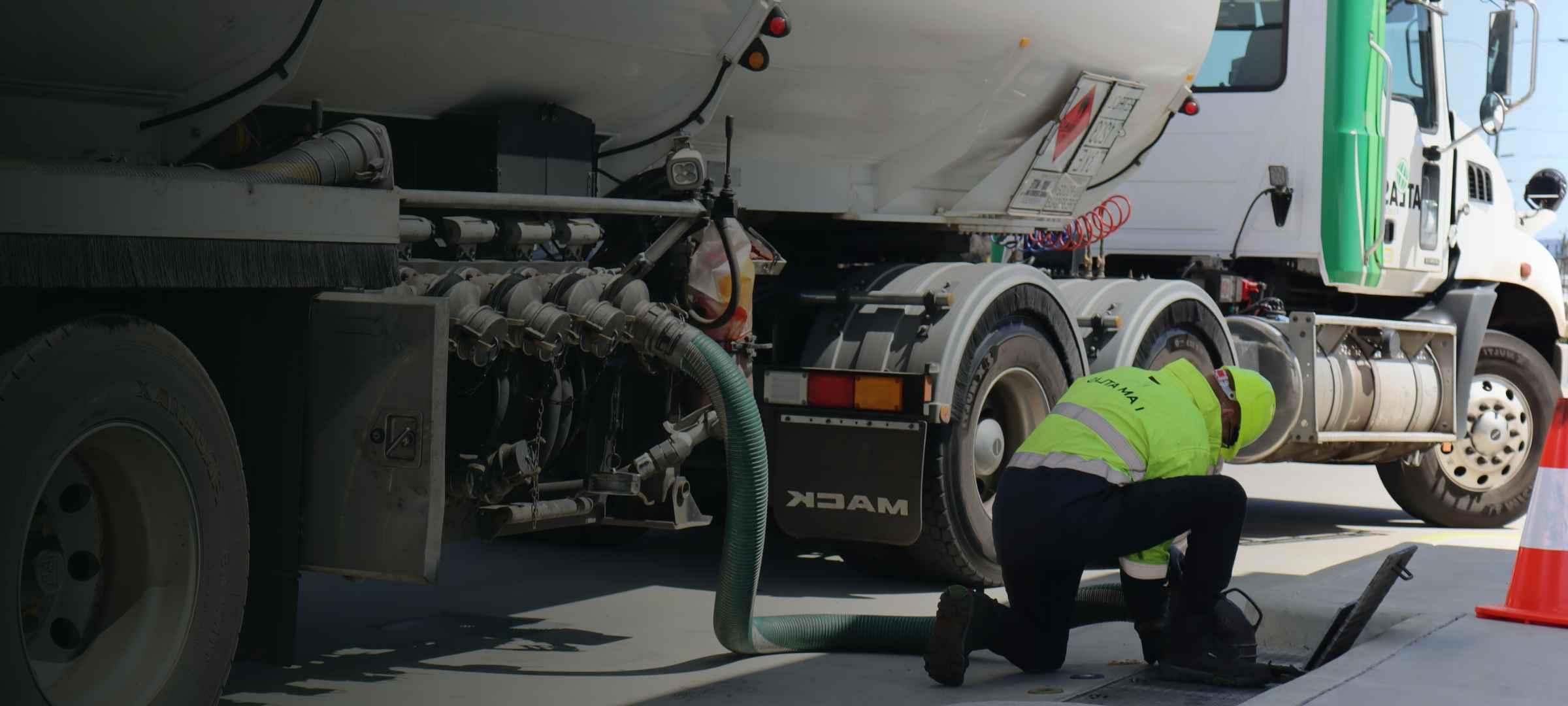
Product is loaded against the order at a terminal or supply point. Grade, litres and vehicle travel with the truck. On site the driver confirms the tank, the fill point and the ullage, lays the hose on the agreed path, and meters the drop. A person authorised to accept fuel signs the docket. From that signature the litres are the site's to store and to burn.
Dip or gauge before the hose goes on and again when it comes off. Agree a tolerance in the account. Meter resolution, tank shape, hose contents and temperature explain a small gap. Past that tolerance, settle it while the driver is still on the pad. Clear the hose into the customer's tank, then read the meter. Product drained back to the tanker after the meter has counted it is a short delivery.
Mark the fill points. A waste-oil tank beside the diesel, or a generator day tank beside the bulk tank, is how the wrong vessel gets a hose. Day tanks are fed from the main storage. The supplier fills the main tank. Put the tank identification on the order and on a tag readable from the connection. One person owns the reading. A second name on the account is the backup. Two people ordering the same tank will eventually double-fill it.
Before the first loaded truck, photograph the coupling, measure the hose run, and note overhead lines and soft ground. File the chart, the safe fill and who may sign. The second drop should feel dull.
The vehicle is a payload, a turning circle and a legal route. Brochure capacity is a ceiling. Mass limits, batch density and the season move the litres. Ask what the nominated truck carries on your road, and keep safe fill above the minimum for that run.
A rigid tanker suits tighter yards, smaller tanks and sites where a semi cannot turn. Payload follows the axles and the mass the road allows. Use one when the drop is modest and the pad is awkward, and get that truck's litres for your route. A figure copied from another operator's flyer fails at the first gate.
A semi-trailer is the usual highway unit for bulk fuel delivery into commercial yards, farms on sound roads, and many industrial sites. It needs room to enter, to stand with the hose out, and to leave. A blind reverse through a crew means the vehicle is wrong for the pad. B-doubles and road trains, doubles and triples, move large volumes on gazetted roads where the site can take them. A triple that is legal inland can still be the wrong truck for a farm gate, a low bridge or a yard built for a rigid. Inland Western Australia, the Territory and parts of Queensland run those combinations only on the roads gazetted for them.
Diesel is sold in litres and loaded against a mass limit. Automotive diesel commonly sits around 0.82 to 0.85 kilograms per litre at 15°C, and the morning's batch can sit anywhere in a band like that. A heavier batch reaches the axle limit in fewer litres. A warmer, lighter litre weighs less, so the same combination shows more volume before it hits the cap. Quote what that truck delivers on that route, in that season.
Walk the entrance for the combination you have ordered. Gate width, the corner the trailer cuts, overhead power, a cattle grid and the ground after rain all change the job. A forty-metre hose across a haul road is a different drop from a fill point beside the pad. Say so before the first load if the truck must stand on a public road. A bogged tanker is a recovery and a spill risk. On mining sites the induction, the call-up and the shift window often decide the vehicle as firmly as the litres do. Commercial yards more often fail on a locked gate at the start of the shift, or a tank nobody dipped. Say which constraint is yours when the order goes in.
Once the truck is in position the job is hydraulics: head, hose diameter, hose length, fill height, and whether the tanker pumps or drops by gravity. Bulk hose is commonly 50 to 100 millimetres. A smaller bore hurts flow much more than a few extra metres of the right hose. Measure the run. Fifteen metres on the plan and forty on the pad means a slow pump and hose joined on the clock.
Gravity works when the outlet sits above the fill and the run is short. Pump when the tank is on a stand, the hose is long, or the window is tight. Every metre of lift costs pressure. The pump loads every coupling, every tired camlock gasket and every kink under a wheel. Open the valve slowly, watch the joint, then bring the flow up. A gasket that holds at a trickle can let go once the pump is on.
Confirm the coupling before the first loaded visit. Camlock is common on above-ground farm and site tanks. Some fills are flanged, some are dry-break, and some older tanks still have a thread nobody has checked in years. Standardise the fill. An adaptor from a drawer is another leak. Watch the vent. A tank filled faster than it can breathe will push back or spit, and the meter keeps counting while the tank refuses the product. Paint, a mud-wasp nest or a gauge line across the vent is a reason to stop.
Stand clear of the hose, out of the bight, with a way to signal the person at the pump. Close or flag any haul road or aisle the hose crosses. Tanker meters on this work are commonly positive displacement meters, printing a start and finish or a delivered volume. Ask, before the first invoice, whether those litres are ambient or temperature-corrected. A broken calibration seal is a reason to pause. The dip checks the tank. The meter is what the account is priced on. A settled tank or a bent dip tape will argue with a good meter on every load.
Diesel volume moves with temperature. About 0.08 percent per degree Celsius is close enough for the pad. The meter ticket, or a proper correction table, settles the invoice. Australian petroleum measurement uses 15°C as the reference. Warm product occupies more volume than the same mass corrected back to that temperature. Ten degrees is about 0.8 percent, in the order of 300 litres on a 40,000 litre drop. The contract has to say which of those litres is being sold.
Take 30,000 litres observed at 30°C. Fifteen degrees above the reference is about 1.2 percent, so the same product corrected toward 15°C is in the order of 29,600 standard litres. Nothing is missing. The ticket may show ambient litres, litres corrected to 15°C, or both. Match the dip to the invoice on the same basis, inside the agreed tolerance. A warm dip beside a corrected invoice will miss, and that miss is expected.
A morning-after dip can move again. Warm product contracts in a cooler tank, and an above-ground tank that heats through the day expands. Record the time with the reading. If one load still sits far outside the usual gap, hold the docket and take a sample from a drained, clean point, labelled with the docket number, the tank and the time. Water, a wrong grade or the wrong tank chart will not yield to a conversion factor.
Ullage is the empty volume you meant to leave. That headspace is also vapour space: room to expand, and room for the tank to breathe. At about 0.08 percent per degree, a 20 degree rise is about 1.6 percent. On 50,000 litres that is hundreds of litres if the product itself warms that much. An above-ground tank filled to the neck on a cool inland morning can push product out the vent by afternoon. A buried tank moves less.
Diesel is handled as a combustible liquid, and the tank, vent and bund still have to be fit for it under AS 1940 and the site's own rules. Safe fill is often around 95 percent of nominal capacity, sometimes lower where the site has set its own mark. Order against that mark. Shell capacity includes volume you are meant to leave empty.
Dip or read the gauge, convert with that tank's chart, subtract from the safe fill, then subtract product already on order. Order that figure or less. Stop at the mark even if the paperwork asked for more. The driver needs a gauge the site trusts, a working high-level alarm, or a person on the vent. A whistle vent is a last warning. Stand clear of it. If a float valve chatters, stop. Forcing product past it loads the vent and the shell.
On inland sites the same headspace breathes. A large day-to-night swing pulls moist air in through a poor cap, and that moisture becomes the next water bottom. A sound cap, a cowling turned from the weather, and a hatch that seals keep it out. A blocked vent during the fill is the urgent case. Stop, clear it, then start again.
A bund works when it has room. Stormwater, a cracked wall, an open drain valve or an unsealed pipe turns it into a path off the pad. If last month's rain is still in the compound, pump it to an approved point before the hose goes on. Most compounds built to AS 1940 are sized to hold the largest tank, with a margin. That size is useless while the valve is open and the compound is already half full.
Self-bunded tanks, with an integral outer skin, are common on farms and small commercial sites. Product in the interstice means the primary wall has already leaked. Deal with that before the next delivery. Fill, vent and dip stay on the inner tank. The hose connection often sits outside the compound, so a failed gasket dumps product on the pad. Keep the spill kit at the connection.
Terminal diesel is filtered on the way into the tanker. The site tank is where a clean load gets spoiled: water, scale, a hatch that lets rain in, and microbial growth at the fuel-water interface. The incoming stream stirs the bottom. A fresh delivery onto a dirty tank is a common reason a yard of machines blocks filters the same afternoon.
Water sits at the low point. Water-finding paste on the dip shows it. Drain it through the proper valve into a container. A deep bottom and no drain means you hold the delivery and say so before the truck leaves the depot. A new load will stir that bottom. Hazy fuel, a dark rag layer, slime or a smell that is wrong points to growth at the interface. Get the water out, and stop more getting in, before anyone talks about biocide.
Where the product itself is in doubt, fuel testing separates a bad tank from a bad load. Label the sample with the docket number, the tank and the time, and keep that fuel out of equipment while you wait. Ask whether the tanker carries diesel only. A compartment last used for petrol can leave a low-flash mixture in a diesel tank, and the engines will show it.
A strainer on the tanker protects the meter. The filter that protects a modern injector sits on the line out of the tank, commonly around 10 micron or to the equipment maker's figure, often with a water-absorbing stage. Change elements on condition or hours. A collapsed element left in the housing is a bypass. If blocked filters arrive with a new delivery, isolate the tank, check the water and whether the suction was picking up from the bottom, then call with the docket number.
Name the grade from the product range you have agreed. Road diesel in Australia is 10 ppm sulphur. If an engine warranty or a site specification calls for a particular grade, write that grade on the order. The single word 'diesel' leaves the lift point to assume.
Most spills on a routine drop are small: a weeping gasket, a hose drained at disconnect, a sneeze from the vent. Keep pads, a drain plug, gloves and a waste bin at the connection, and a way to block the path if the pad falls toward stormwater. The truck carries the supplier's gear. The fill point carries the site's. Agree who rings whom. If product reaches a drain or soaks soil, follow the site incident rule while the volume is still easy to estimate. Reporting duties differ by state, and again if water is involved. Write down what left the hose.
Mines and principal contractors will ask for a safe work method statement, or a procedure that does the same job. Put this pad's reversing rule, exclusion zone and hot-work distance in it. A farm may never use that document. The controls are the same: a clear hose path, someone on the vent, a kit at the connection, light at night, and a way to stop the pump.
A pad the driver has refused, a reverse the site rules forbid, or a wait that wrecks the rest of the driver's hours sits with the people who insisted. Chain of responsibility language varies by state. On the pad, leave the driver with a setup you would stand next to yourself. A dispatcher who backs that refusal is doing the job.
The minimum drop, sometimes called a minimum order quantity, pays for the kilometres, the driver's time and the terminal lift. It belongs to the route. A metro rigid is often scheduled around a few thousand litres. A remote road-train cycle sits far higher. Get the number for your address in writing before you size the tank or set the reorder point.
If the tank cannot take the minimum, choose the fix on purpose: a larger tank, a smaller vehicle at a higher freight rate per litre, or a split across tanks on the same site that have the ullage. Finding out at the gate wastes the window. A loaded truck needs another customer's ullage, grade and consent before those litres can go elsewhere. Ask what an aborted delivery costs once the product has left the gantry.
Set the reorder at burn rate times the lead time you actually get, plus a buffer for delays you have already seen. A Perth yard on a planned run can sit inside a short cycle if the order hits the cut-off. A pastoral tank, a marine job waiting on a berth, or a mine that receives only on certain shifts is on the truck's cycle. Farm supply that was simple in March can be a queue in harvest. In the north, a road open last week can shut after rain. Public holidays and a terminal outage belong in the buffer. If a Thursday before a long weekend has already been missed once, the tank has to reach the Tuesday after.
The depot queue is gantry slots, driver hours, inductions and trucks already committed. Miss the cut-off and the call-off waits. Atlas Fuel rosters its own tankers, so a Western Australian window can be moved by the dispatch that rostered the driver, across Perth and regional WA. Agreed runs into Queensland and Victoria take the lead time those kilometres require. A full Friday roster still has a ceiling.
Know which litre you are buying. A terminal gate price plus a stated differential, with freight beside it, can be checked when fuel prices move. A fixed delivered price sits cleanly in a job budget until supply tightens and loads slip. Write freight, the minimum, waiting and after-hours as their own lines, and match the priced litre to the docket: ambient or corrected to 15°C. State how many minutes of waiting are included, and the rate after that.
An after-hours drop is the same transfer with fewer people, poorer light, and a driver closer to the end of the available hours. The fee is higher because the roster, the terminal and the risk have changed. Call with the reading, the time the critical machine stops, the gate arrangement, and a person who will sign. Ask what volume can still move. The truck already out may be part-loaded.
Atlas Fuel's dispatch provides 24/7 emergency onsite diesel across Perth, Kwinana Beach and regional Western Australia, when the site will open. Planned work in other states runs on its own lead time. Confirm the induction is valid after dark. Some mines will only receive an escorted driver, and some farms open the gate at daylight. Night still needs light on the connection and on the way out.
Eligible businesses may claim fuel tax credits on diesel used in qualifying activities, including some off-road plant and some heavy-vehicle use. Rates and the split between off-road use and on-road use in a heavy vehicle change. Check the current Australian Taxation Office settings before a credit is built into a margin. The docket records the purchase: date, litres, grade, site, tank and a signature. Eligibility follows the ATO rules and how the site burned the fuel.
Where one tank feeds both eligible plant and a use outside the claim, the site splits the litres. Keep signed dockets with the fuel account for the period the ATO expects. On a disputed load, that docket sits with the dip notes, the filter history and any sample label.
When those points are true, the drop is routine. When they are still being sorted as the truck turns in, you are buying waiting time. If the account covers yards, farms and project sites, say so when you ask about services. The product can be the same and the window completely different. Send the safe fill, the tank chart if you have one, the address, the coupling and the week the burn rate spikes through contact. With those, a schedule can be built around the tank. A litre rate on its own is a guess.
Straight answers to the questions site managers, fleet controllers and farm operators usually raise before locking in a fuel account.
Name the site, the tank, the safe fill, the grade, the litres and the window, plus who will sign, and the limits on the truck: induction, hose length, coupling, and whether a semi can turn. A pin on a farm track still needs the gate. Give a second tank its own ullage. One combined figure is how a day tank receives a bulk hose.
Temperature, tank shape, hose contents and whether the litres are ambient or corrected to 15°C all move the two readings. About 0.08 percent per degree is the field factor. Fifteen degrees is roughly 1.2 percent, a few hundred litres on a large drop. Dip before and after. Outside the agreed tolerance, keep the driver, keep the docket, and sample before more of that fuel is used.
Use the safe fill, often around 95 percent of nominal capacity or a lower mark the site has set, and leave more if an above-ground tank will warm through the day. A 20 degree rise is about 1.6 percent, hundreds of litres on a 50,000 litre tank, enough to weep from a vent if you filled to the neck in the morning. Order from the chart, subtract loads already coming, and stop at the mark.
Say so before the truck leaves the depot. A clean load onto a water bottom gets stirred, and the filters wear the blame. Drain water to a container where the tank allows it. Hazy fuel, slime or a wrong smell means you hold the delivery and test against the docket number. Ask whether the tanker carries diesel only. Petrol in the previous compartment is a separate fault.
Distance, vehicle and time set the minimum, and the figure belongs to your address. A few thousand litres is a common metro rigid number. A remote combination is often much higher. If the tank is smaller, enlarge it, take a smaller vehicle and the freight that goes with it, or split the drop across tanks on the site. Ask what a loaded truck costs if the site cannot take it.
Order to the cut-off, then buffer for weather, holidays, terminal queues and the season. Remote and shift-bound sites run on the truck cycle. After hours, call with the reading, when the critical machine stops, and who can open the gate and sign. Across Perth, Kwinana Beach and regional Western Australia, Atlas Fuel runs a 24/7 emergency onsite path when the site can receive the truck. Night still needs light, a valid induction and ullage.
Write the basis down. A terminal gate price plus a differential, with freight, the minimum, waiting and after-hours listed beside it, can be checked as the market moves. A fixed price is simpler to budget until loads start to slip. Match the priced litre to the docket, ambient or corrected to 15°C.
Keep the signed docket: date, litres, grade, site, tank, and whether the volume is ambient or corrected. That is the purchase record a fuel tax credit file rests on. Eligibility, the rate, and any split between off-road plant and an on-road heavy vehicle sit with the ATO and the site's usage records. For a dispute, keep the dip notes, filter history and sample label with that docket.


